
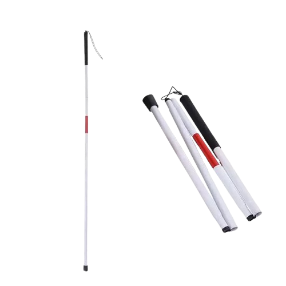
Blind walking cane/White cane in kenya
(0)A blind walking cane, often referred to as a white cane or mobility cane, is a tool used by individuals who are blind or visually impaired to navigate their surroundings safely. The cane is used to detect obstacles in the person's path, identify changes in the terrain, and convey to others that the user has a visual impairment.
In stock
SKU: blind-walking-cane-white-cane in kenya
Categories: Mobility aids,Orthopedic and physiotherapy products.
Product description
Here's a detailed look at the blind walking cane:
- Appearance:
- Typically white, often with a red section near the bottom, to make it easily recognizable as a symbol of visual impairment.
- Length varies depending on the user's height and the type of cane.
- Types:
- Straight Cane: Rigid and non-folding.
- Folding Cane: Collapses into several sections for easy storage.
- Telescopic Cane: Adjustable length and can be retracted.
- Support Cane: Designed for those who need both support for walking and assistance with navigation.
- Tip:
- The bottom part of the cane that makes contact with the ground. It can be made of various materials and comes in different shapes and sizes.
- Some tips are designed to roll, while others are designed to be tapped or slid.
- The choice of tip depends on the user's preference and the environment in which they'll be walking.
- Techniques:
- Two-Point Touch: The user taps the cane side to side, touching the points to the ground to detect obstacles.
- Constant Contact: The cane sweeps from side to side, continuously touching the ground. The rolling tip is often used with this technique.
- Diagonal Technique: Used mainly by people with partial sight, where the cane is held diagonally across the body for protection.
- Purpose:
- Detection: The primary purpose is to detect obstacles in the user's path, such as steps, curbs, holes, and furniture.
- Terrain: It can detect changes in the walking surface, like moving from a sidewalk to grass.
- Vehicular Traffic: Acts as a signal to drivers and pedestrians that the user is visually impaired. In many places, traffic regulations require drivers to stop when a pedestrian with a white cane is crossing.
- Training:
- Proper training, often provided by orientation and mobility (O&M) specialists, is essential. They teach individuals how to use the cane effectively and safely.
- International White Cane Safety Day:
- Celebrated on October 15th, this day aims to increase awareness about the challenges faced by the visually impaired and the importance of the white cane as a tool for independence.
- Maintenance:
- Regularly checking the tip for wear and replacing it as needed is crucial for optimal performance.
Customer reviews
Not rated yet0 reviews
No reviews yet. Be the first to rate this product.
Write a review
Your email address is optional and will not be displayed.
Related products
Sale
Sale
Sale
Sale